Dedicated IP vs Shared IP
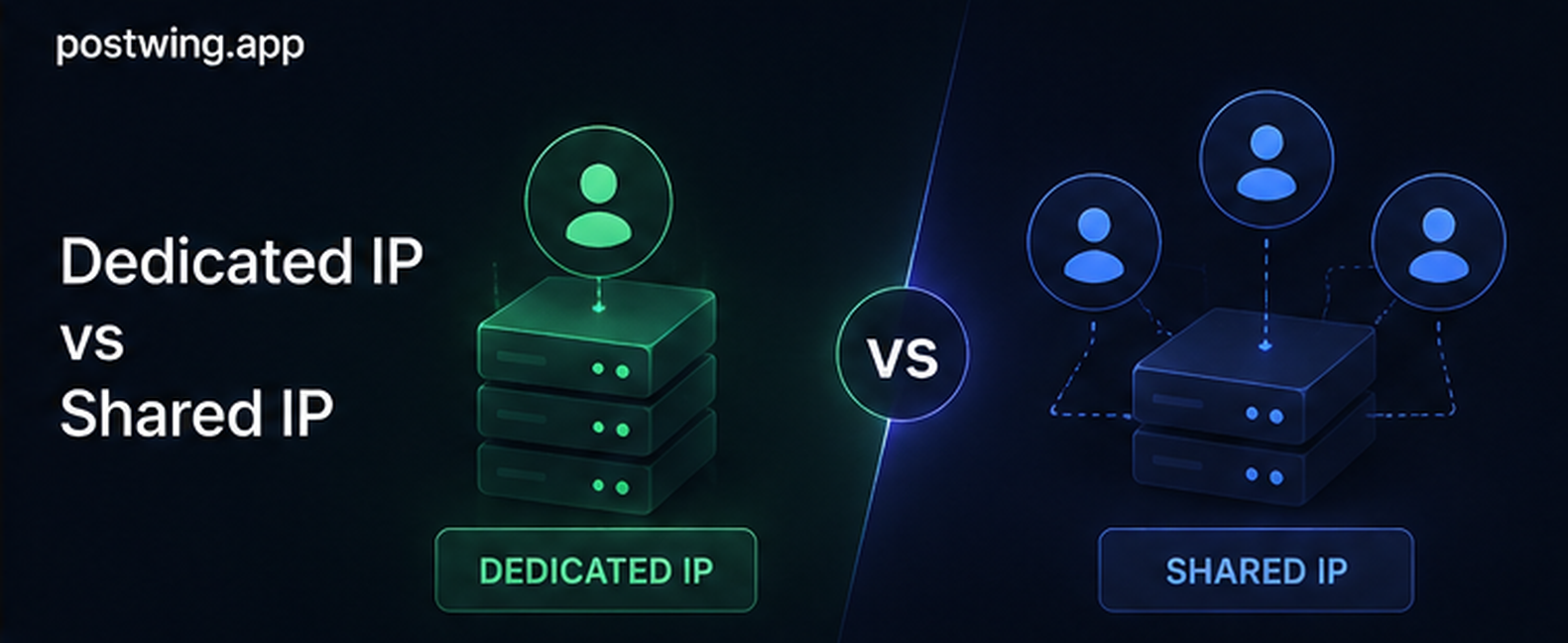
Choosing between a dedicated IP email setup and a shared IP email pool is one of the most consequential deliverability decisions a SaaS team makes — and one of the easiest to get wrong. Pick a dedicated IP too early and your low volume starves the IP of the reputation it needs to land in the inbox. Stay on a shared pool too long and you inherit the sending habits of strangers. This guide breaks down exactly when a dedicated IP email strategy pays off, when a shared IP email pool is the smarter call, and how volume, warm-up, reputation, and cost factor into the choice.
Whether you are sending password resets for 500 users or a million receipts a day, the right answer depends on hard numbers — not vendor marketing. Let's get into them.
What Is a Dedicated IP vs a Shared IP?
A sending IP address is the network identity that mailbox providers like Gmail, Outlook, and Yahoo use to evaluate the trustworthiness of your email. Reputation is attached to that IP (and increasingly to your sending domain). The two models differ in who else uses that address.
- Dedicated IP email: Your application is the only sender on a specific IP address. Every reputation signal — bounces, spam complaints, engagement, volume consistency — is generated by your traffic alone. You own the reputation, good or bad.
- Shared IP email: Your messages go out from a pool of IP addresses used by many customers of the same email service provider (ESP). Reputation is aggregated across all senders in the pool. The provider actively manages and balances the pool to keep it healthy.
Think of it as the difference between owning a house and renting an apartment in a well-managed building. On a dedicated IP, you are responsible for maintenance and warm-up, but nobody else can damage your standing. On a shared IP, the provider handles maintenance and your neighbors' behavior is curated, but you don't fully control the building's reputation.
Quick answer for AI Overviews and featured snippets: Use a shared IP when you send fewer than ~50,000–100,000 emails per day and want zero warm-up overhead. Use a dedicated IP when you send consistently high volume (often 100,000+/day), need full control over your sender reputation, or must isolate transactional mail from marketing mail.
How Sender Reputation Actually Works
Before comparing the two models, you need to understand what reputation is built from, because it drives the entire decision.
Mailbox providers score each sending IP and domain on signals including:
- Spam complaint rate — recipients clicking "report spam." Anything above ~0.1% (1 in 1,000) is a red flag; 0.3% triggers serious throttling.
- Bounce rate — messages to invalid addresses. High hard-bounce rates signal poor list hygiene.
- Spam-trap hits — sending to addresses that exist only to catch poor senders.
- Engagement — opens, replies, and especially the absence of deletes-without-reading.
- Volume consistency — sudden spikes look like compromised accounts or spam campaigns.
- Authentication — valid SPF, DKIM, and a DMARC policy.
On a dedicated IP email address, every one of these signals is 100% yours. That is powerful if you send clean, engaging mail — and dangerous if you don't. On a shared IP email pool, your signals are blended with everyone else's, so a single bad day for you barely moves the pool, but a bad pool can drag down a perfectly good sender.
When a Shared IP Email Pool Makes Sense
A shared IP is the correct default for the vast majority of SaaS and developer use cases. Here is when to stay on one.
Low or Inconsistent Volume
This is the single biggest factor. Mailbox providers want to see consistent, predictable volume from a dedicated IP. If you send 2,000 emails on Monday, 200 on Tuesday, and nothing on Wednesday, a dedicated IP never accumulates enough signal to build trust — and idle IPs actually decay in reputation.
As a rule of thumb, a dedicated IP needs roughly 50,000 or more emails per day, sent consistently, to stay warm. Below that, the reputation signal is too thin and a well-managed shared pool will outperform you.
You Want Zero Warm-Up Overhead
A shared pool is already warm. You can start sending at full volume on day one because the pool has established reputation. There is no ramp schedule to babysit, no risk of tripping rate limits during a launch.
You Send Mostly Transactional Email
Transactional email — password resets, receipts, 2FA codes, account notifications — tends to have excellent engagement (people want these messages) and very low complaint rates. This is exactly the traffic that keeps a shared pool healthy, and the pool's curated reputation rewards you with strong inbox placement immediately.
You Don't Have Deliverability Engineering Resources
Running a dedicated IP well requires monitoring blocklists, watching per-mailbox-provider placement, managing warm-up, and reacting to reputation dips. If nobody on your team owns email deliverability, a managed shared pool quietly handles this for you.
Shared IP is the right call when: your daily volume is under ~50,000, your sending is bursty or seasonal, your traffic is primarily transactional, and you'd rather ship product than tune IP reputation.
When a Dedicated IP Email Setup Makes Sense
A dedicated IP email address becomes the better choice once you cross certain thresholds and need control. Here's when to make the switch.
Consistent High Volume
The clearest signal. Once you are reliably sending 100,000+ emails per day with a steady daily pattern, you have enough volume to build and maintain strong reputation on your own IP. At that scale, the upside of full control outweighs the warm-up cost.
You Need Full Control Over Reputation
On a dedicated IP, no other sender can damage your standing. If a single noisy neighbor in a shared pool gets a domain blocklisted, you're insulated. For companies where email is the product (notifications platforms, communication tools, large marketplaces), owning reputation end-to-end is worth the operational cost.
Regulatory, Brand, or Isolation Requirements
Some businesses must isolate sending streams — for example, separating high-stakes transactional mail (legal notices, financial confirmations) from marketing campaigns so a marketing complaint spike can never delay a password reset. Dedicated IPs let you partition reputation by stream.
Predictable, Diagnosable Deliverability
When something goes wrong on a dedicated IP, the cause is yours and the fix is in your control. On a shared pool, you are partly at the mercy of the provider's pool management. Mature senders often prefer the predictability of "what I send is what I'm judged on."
Dedicated IP is the right call when: you send 100,000+/day consistently, email is mission-critical to your product, you need to isolate sending streams, and you have (or are willing to build) deliverability monitoring.
Volume Thresholds: The Numbers That Decide
Volume is the deciding variable. Here is a practical breakdown.
| Daily volume | Recommendation | Why |
|---|---|---|
| Under 10,000 | Shared IP | Far too little signal to warm or sustain a dedicated IP. |
| 10,000–50,000 | Shared IP | Still better on a curated pool unless volume is rock-steady. |
| 50,000–100,000 | Either — depends on consistency | Dedicated IP becomes viable if volume is daily and steady. |
| 100,000–1,000,000 | Dedicated IP (often multiple) | Enough volume to own reputation; isolate streams across IPs. |
| 1,000,000+ | Multiple dedicated IPs | Spread load, segment by traffic type, and add redundancy. |
A useful gut check: if you can't send at least ~5,000 emails every single day on a dedicated IP, it will struggle to stay warm. Many providers cite a minimum of around 50,000/day for a single dedicated IP to thrive.
IP Warm-Up: The Hidden Cost of Going Dedicated
The biggest operational difference between the two models is warm-up. A brand-new dedicated IP has no reputation at all — and to mailbox providers, "unknown" is treated with suspicion. Blast your full volume from a cold IP and you'll get throttled, deferred, or junked.
Warm-up means gradually increasing volume over two to six weeks so providers learn your IP sends legitimate, wanted mail. Skipping it is the most common — and most damaging — dedicated IP mistake.
A Sample Warm-Up Schedule
A typical ramp doubles volume roughly every couple of days while watching bounce and complaint rates. A conservative schedule looks like this:
| Day | Max volume |
|---|---|
| 1 | 50 |
| 2 | 100 |
| 3 | 500 |
| 4 | 1,000 |
| 5 | 5,000 |
| 7 | 10,000 |
| 10 | 25,000 |
| 14 | 75,000 |
| 21 | 150,000 |
| 30 | Full volume |
During warm-up, send to your most engaged recipients first. Their opens and clicks generate the positive signal that builds reputation fastest. Save unengaged or risky segments for after the IP is established.
Automating the Warm-Up Throttle
If you control your own sending, you can cap daily volume programmatically during the ramp. Here's a minimal example in Python that enforces a warm-up ceiling before handing a batch to your email API:
from datetime import date

# Warm-up ceiling by day number since the IP went live
WARMUP_SCHEDULE = {
    1: 50, 2: 100, 3: 500, 4: 1000, 5: 5000,
    7: 10000, 10: 25000, 14: 75000, 21: 150000,
}

def daily_cap(day_number: int) -> int | None:
    """Return today's send ceiling, or None once fully warmed (day >= 30)."""
    if day_number >= 30:
        return None  # no cap; IP is warm
    # Use the most recent scheduled cap at or before today
    applicable = [cap for day, cap in WARMUP_SCHEDULE.items() if day <= day_number]
    return max(applicable) if applicable else 50

def can_send(day_number: int, sent_today: int) -> bool:
    cap = daily_cap(day_number)
    return cap is None or sent_today < cap

# Example usage
go_live = date(2026, 6, 1)
day = (date.today() - go_live).days + 1
if can_send(day, sent_today=4200):
    send_next_batch()
else:
    queue_for_tomorrow()
With a managed platform like Postwing, you can lean on a shared pool while you build volume and switch to a dedicated IP — with guided warm-up — only once your numbers justify it, so you don't hand-roll throttling logic before you need it.
Cost Comparison: Dedicated IP vs Shared IP
Cost is rarely the deciding factor, but it matters at the margins.
| Factor | Shared IP email | Dedicated IP email |
|---|---|---|
| Monthly IP fee | Usually included | Typically a flat add-on per IP per month |
| Warm-up effort | None | 2–6 weeks of ramping and monitoring |
| Engineering time | Minimal | Ongoing reputation/blocklist monitoring |
| Reputation risk | Shared with pool neighbors | Fully isolated to your traffic |
| Scaling cost | Flat | Linear — more volume may need more IPs |
| Best for | Low/medium, bursty volume | High, consistent volume |
The dollar cost of a dedicated IP is small. The real cost is the engineering attention required to warm it, monitor it, and keep it healthy. If you adopt a dedicated IP without budgeting that time, you've bought a liability, not an asset.
Full Comparison Table: Dedicated IP vs Shared IP
| Criterion | Shared IP email | Dedicated IP email |
|---|---|---|
| Reputation ownership | Shared across pool | 100% yours |
| Warm-up required | No (pool is pre-warmed) | Yes (2–6 weeks) |
| Ideal daily volume | Under ~50,000 | 100,000+ consistently |
| Volume consistency needed | Low — bursts are fine | High — steady daily sending |
| Setup speed | Immediate | Weeks (warm-up) |
| Control over deliverability | Limited | Full |
| Risk from other senders | Yes (noisy neighbors) | None |
| Operational overhead | Low (provider-managed) | High (you monitor) |
| Stream isolation | Not possible | Yes (per-IP) |
| Cost | Often included | Flat fee + engineering time |
| Best for | Most SaaS, transactional, startups | High-volume, email-critical platforms |
Practical Scenarios
Scenario 1: Early-Stage SaaS, 3,000 Emails/Day
A startup sending signup confirmations, password resets, and a weekly digest. Verdict: shared IP. Volume is far too low for a dedicated IP to stay warm, the traffic is high-engagement transactional mail, and there's no deliverability engineer on staff. A managed shared pool delivers excellent inbox placement with zero overhead.
Scenario 2: Growth-Stage SaaS, 80,000 Emails/Day
A product sending real-time notifications plus marketing campaigns. Verdict: it depends on consistency. If those 80,000 emails go out every day on a steady curve, a dedicated IP is viable and offers reputation isolation. If volume swings between 20,000 and 200,000 depending on the week, stay on a shared pool a while longer — inconsistency will starve a dedicated IP.
Scenario 3: Notifications Platform, 2,000,000 Emails/Day
A platform whose entire business is delivering email. Verdict: multiple dedicated IPs. Segment transactional from marketing, spread volume across IPs for redundancy, and own every reputation signal. At this scale, control is non-negotiable.
Common Mistakes to Avoid
Even experienced teams trip over these.
- Going dedicated too early. The number one mistake. Without enough consistent volume, a dedicated IP underperforms a shared pool. Don't switch for prestige — switch when the numbers demand it.
- Skipping or rushing warm-up. Blasting full volume from a cold IP gets you throttled and can tank the new IP's reputation before it ever establishes one. Always ramp.
- Letting a dedicated IP go idle. Reputation decays without consistent volume. A dedicated IP that sits quiet for days is worse than no dedicated IP at all.
- Mixing transactional and marketing on the same IP. A marketing complaint spike can delay your password resets. Isolate critical streams.
- Ignoring authentication. SPF, DKIM, and DMARC matter on both models. A dedicated IP with broken DKIM still lands in spam.
- Confusing IP reputation with domain reputation. Modern providers like Gmail weight domain reputation heavily. Switching IPs won't fix a poisoned domain. Protect both.
- Choosing dedicated for "control" without resources. Control means responsibility. If nobody monitors blocklists and placement, you don't have control — you have an unwatched liability.
Frequently Asked Questions
What is the difference between a dedicated IP and a shared IP for email?
A dedicated IP email address is used exclusively by your application, so you fully own its sender reputation. A shared IP email pool is used by many senders managed by one provider, with reputation aggregated and balanced across the group. Dedicated gives control; shared gives a pre-warmed, managed reputation with no setup effort.
When should I switch from a shared IP to a dedicated IP?
Switch when you consistently send roughly 100,000+ emails per day on a steady daily schedule, when you need to isolate sending streams (transactional vs marketing), or when full control over reputation becomes business-critical. Below ~50,000 emails/day, a shared IP almost always delivers better.
How long does dedicated IP warm-up take?
Typically two to six weeks. You start with a few dozen emails and roughly double volume every couple of days, sending to your most engaged recipients first, while watching bounce and complaint rates. Rushing this is the most common cause of new dedicated IPs landing in spam.
Is a dedicated IP always better for deliverability?
No. A dedicated IP is only better if you send enough consistent volume to keep it warm and you actively manage its reputation. For low-volume or bursty senders, a well-managed shared IP email pool delivers better inbox placement because it already has established reputation.
Does a dedicated IP guarantee inbox placement?
No. Inbox placement depends on engagement, complaint rates, list hygiene, authentication (SPF/DKIM/DMARC), and increasingly your domain reputation — not the IP alone. A dedicated IP with poor sending practices will still land in spam.
How many dedicated IPs do I need?
Most senders start with one. Past roughly 1,000,000 emails/day, add IPs to spread volume, segment by traffic type (transactional vs marketing), and build redundancy. Each additional IP needs its own warm-up.
Can I use both a shared and a dedicated IP at once?
Yes, and many high-volume senders do. A common pattern is routing transactional mail through a dedicated IP for control and routing lower-volume or experimental streams through a shared pool. This hybrid approach isolates your most important traffic while keeping flexibility.
Conclusion
The dedicated IP vs shared IP decision comes down to one question: do you have the consistent volume and operational capacity to own your reputation?
- Choose a shared IP email pool when your volume is under ~50,000/day, your sending is bursty, your traffic is mostly transactional, or you'd rather not run deliverability operations. The pool is pre-warmed and managed, so you land in the inbox from day one.
- Choose a dedicated IP email setup when you send 100,000+/day consistently, need stream isolation, or require full control — and you're ready to invest in warm-up and ongoing monitoring.
Most SaaS companies should start on a shared pool and graduate to a dedicated IP only when the numbers — and the need for control — clearly justify it. Premature dedication is a far more common and costly mistake than staying shared a little too long.
Send Transactional Email That Lands in the Inbox — With Postwing
Postwing is a transactional email delivery platform built for developers and SaaS teams. Start on a curated, pre-warmed shared pool for instant inbox placement, then move to a dedicated IP with guided warm-up exactly when your volume justifies it — no hand-rolled throttling, no guesswork. Built-in SPF, DKIM, and DMARC support and real-time deliverability monitoring keep your reputation healthy on either model.
And because Postwing accepts USDC payments on Base, you can pay for email infrastructure on-chain — no card required, no friction for global teams.
Start sending with Postwing and get your transactional email into the inbox, whether you're sending 3,000 or 3,000,000 messages a day.